
 Get a quote
How GMP and FSSAI Certifications Impact Feed Raw Material Quality
20 Jul 2026 - Admin
Most feed buyers focus on price per tonne and protein percentage. This is understandable as these numbers are what show up on every invoice and comparison sheet. But here’s what those numbers don’t tell you: whether that protein was actually tested, whether that batch was traced back to its grain source and whether the facility that produced it operated under any verified quality system. This is where everything changes. That is where GMP and FSSAI certifications in feed raw material quality change everything.
If you’re a feed manufacturer or livestock farmer across Punjab, Haryana, Rajasthan, Uttar Pradesh, Maharashtra and Gujarat, the bag label on the Rice DDGS, Corn DDGS or Guar Korma is just the starting point.
Understanding what FSSAI animal feed standards and GMP-certified animal feed requirements demand is important for serious feed buyers. This is the foundation of sourcing decisions that are protect your animals, your formulations and your business.
At Prodigy Foods, we supply every product with laboratory-tested quality assurance in feed ingredients. This is ensured from Rice DDGS and Corn DDGS to Rice Gluten Meal, Maize Gluten, Guar Korma, Roasted Guar Korma and Maize Fiber. Dive into this guide to know how GMP and FSSAI certifications impact feed raw material quality.
India’s Feed Industry: Why Feed Safety Compliance Matters Now
The animal feed market of India is not small. It is not slow-moving either. So the consequences of any poor feed raw material quality in India are felt at a national scale:
- The Indian animal feed market reached INR 1,186.30 billion in 2025. It is also projected to reach INR 2,112.96 billion by 2034 at a CAGR of 6.6%. (IMARC Group, 2025)
- The livestock sector of India contributed 5.49% of total GVA in 2023 to 24 and is growing at a CAGR of 12.77% since 2014 to 15. India is the world’s largest milk producer, reaching 247.87 million tonnes in 2024 to 25. (DAHD Annual Report 2024)
- FSSAI made BIS compliance mandatory for commercial feed companies which effective from January 2021. This is tightening the FSSAI animal feed standards for all feeds intended for milk and meat producing animals. (USDA FAS / FSSAI, 2021)
- Feed manufacturers are increasingly choosing certified feed raw material suppliers in India across Punjab, Haryana and Rajasthan. The goal is to cut formulation variability and meet the quality requirements of larger buyers.
The sector is too large and too connected to milk, meat and egg production to be able to absorb the cost of unverified ingredients.
How GMP and FSSAI Certifications Impact Feed Raw Material Quality
GMP, Good Manufacturing Practice, is a production and process control system that ensures raw materials are consistently manufactured, contamination-free and tested against declared specifications. GMP+ goes a step further in the animal feed sector. It layers HACCP, Hazard Analysis and Critical Control Points, principles on top of GMP. This is the international benchmark for any GMP certified animal feed supplier.
A genuine GMP certified animal feed manufacturer maintains:
Raw material sourcing controls: Only approved and traceable inputs can really enter production. This matters especially for byproduct ingredients like Rice DDGS and Maize Gluten. Grain quality shifts in these with region and season.
Process validation: Steps like drying temperatures, moisture reduction and protein concentration are documented and verified on every run.
- Batch traceability: Each of the batch can be traced to its input origin as well as production records. You can find exactly where if something goes wrong,
- Laboratory testing before dispatch: Protein, moisture, oil, fibre and energy are independently measured. These aren’t estimated from the averages of last month. This is what verified feed raw material quality in India actually looks like.
GMP+ is built on the ISO 9001 framework. This means that a GMP certified feed raw material supplier is not just running spot checks. They are operating a full quality management system.
What FSSAI Animal Feed Standards Require
FSSAI, Food Safety and Standards Authority of India, is what governs the food safety across the entire human food chain of India. FSSAI animal feed standards exist because what goes into feed does not stay in the animal. It actually shows up in meat, milk and eggs.
FSSAI mandated this under theFood Safety and Standards Amendment Regulations 2020, effective January 2021:
- Feed raw materials for milk and meat producing animals must comply with BIS (Bureau of Indian Standards) specifications.
- Mycotoxin limits: particularly Aflatoxin M1, detected in Indian milk samples in the National Milk Quality Survey 2018 must be controlled at the ingredient level. This must be done before the feed ever reaches the animal.
- Heavy metal concentrations and antibiotic residues must stay within the defined thresholds to protect the human food chain.
Sourcing from FSSAI compliant suppliers isn’t a quality preference anymore. It’s a legal requirement which affects the standing of your finished feed product.
The Aflatoxin Risk and Why DDGS Quality Certification Matters
Here’s the pathway which drove FSSAI to act. Aflatoxin B1 is a toxin which is produced by Aspergillus mould. It can contaminate the grain byproducts including Corn DDGS and Rice Gluten Meal. So when an animal consumes it, their metabolism actually converts it to Aflatoxin M1. This is then secreted in milk and enters the human food supply.
This is why DDGS quality certification with batch-level mycotoxin testing isn’t a box ticking exercise. It’s the mechanism that keeps your diary output fully safe. One uncertified batch with elevated Aflatoxin B1 levels is all it takes.
Common Quality Risks in Uncertified Feed Raw Materials
If you’re sourcing without verified feed ingredient testing, then these are the risks sitting very silently in your supply chain:
| Contaminant / Risk | Impact on Animals | Impact on Feed Business |
| Aflatoxins (B1, M1) | Liver damage, immune suppression and milk contamination | FSSAI non-compliance and rejection by dairy buyers |
| Excess moisture | Mould growth, mycotoxin amplification in storage | Short shelf life, lumping and weight loss |
| Salmonella | Salmonella | Product recall and export ban risk |
| Heavy metals | Chronic toxicity and organ damage | Regulatory action and export rejection |
| Incorrect protein declaration | Under-nutrition, poor FCR and low milk yield | Higher formulation cost and productivity loss |
| Excess ash / sand | Reduced digestibility and gut irritation | Diluted nutritional value and poor ROI |
Why Cheap Feed Ingredients Always End Up Costing More
This is one of the most common lessons feed manufacturers in Maharashtra, Gujarat and Uttar Pradesh learn the hard way.
Uncertified raw materials very often look attractive on paper. You may see a lower price and similar declared specs. But declared is not the same as verified.
Consider this: a dairy feed manufacturer sources 500 MT of Rice DDGS declared at 45% crude protein from an uncertified supplier. Actual protein: 40%. The formulator has no way of knowing. The ration is now 5 percentage points protein-deficient across a 1,000-cow dairy operation. So the result is measurable which is lower milk yield, higher feed cost per litre and increased veterinary bills. That ₹500/MT saving evaporates quickly and then some.
It’s not an really just a upsell if you buy quality-controlled feed raw materials from a certified feed raw material supplier in India. It is what actually protects your margins.
Certified vs Uncertified Feed Supplier: The Real Difference
| Parameter | Certified Supplier | Uncertified Supplier |
| Batch Testing | Every batch and pre-dispatch | Random or absent |
| COA Availability | Standard on every order | Often unavailable |
| GMP Processes | Fully documented | Not documented |
| Batch Traceability | Input to dispatch | Limited or none |
| Mycotoxin Control | Tested per batch | Uncertain |
| Consistent Protein | Validated against declaration | Variable |
| FSSAI Compliance | Yes – BIS aligned | Usually no |
| Export Friendly | Yes | Usually no |
How to Verify Whether a Feed Supplier Is Truly GMP and FSSAI Compliant?
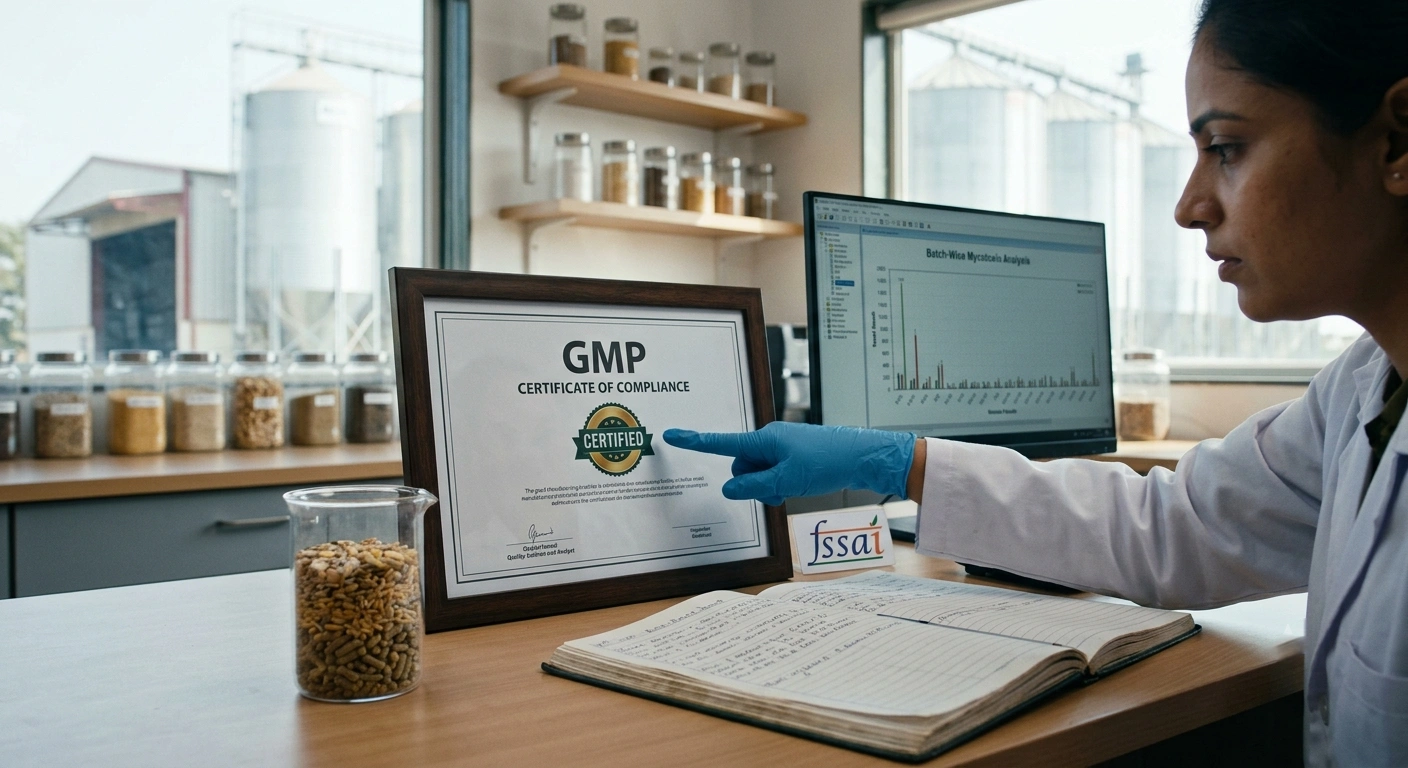
Do not take the supplier’s word for it. Before you place any order, don’t forget to ask for these:
Certificate of Analysis (COA): Batch-specific, covering protein, moisture, oil, fibre, energy and mycotoxin values. Any generic product datasheet isn’t a COA.
Certification documents: Valid and dated GMP or GMP+ certificates. Check who issued them and when they expire.
FSSAI registration or licence number: Cross check it on the FSSAI Food Business Operator portal.
Batch traceability records: Your supplier should be able to tell you the input grain origin, production date and dispatch lot before your specific order.
Mycotoxin test reports: Aflatoxin B1 results from an accredited third-party lab. The internal records alone aren’t sufficient.
BIS compliance confirmation: For raw materials that are covered under 2021 FSSAI mandatory standards.
If a supplier isn’t able to provide these, that tells you what you need to know.
Looking for laboratory tested Rice DDGS, Corn DDGS, or Guar Korma? Prodigy Foods provides batch wise COAs, verified quality data and certified feed ingredients on every order. Request product specifications –
Conclusion
GMP and FSSAI certifications in feed raw material quality aren’t just paperwork. They are the system that makes a declared protein value mean something, that keeps aflatoxins out of your dairy supply and that gives a feed formulator confidence in every ration they build.
The livestock sector of India produces 247 million tonnes of milk a year. The feed that goes into those animals is not a commodity decision. That’s a food safety decision. Feed safety compliance is too consequential to be able to manage on trust and too costly to get wrong.
Working with a verified certified feed raw material supplier in India, one that holds an FSSAI animal feed standard, runs GMP-certified animal feed production and delivers verified DDGS quality certification per batch, is the smartest move. This is the most straightforward way to protect your formulations, your animals and your business.
Prodigy Foods suppliers Rice DDGS, Corn DDGS, Rice Gluten Meal, Maize Gluten, Guar Korma, Roasted Guar Korma and Maize Fiber with laboratory-verified quality data on every dispatch. View our Awards & Certifications or contact us at +91-98763 28135 | info@prodigyfoods.in
Frequently Asked Questions: GMP and FSSAI Certifications in Feed Raw Material Quality
Q1. What is GMP+ certification and how does it apply to feed raw material suppliers?
GMP+ is the specific extension of Good Manufacturing Practices for the animal feed industry. GMP+ incorporates HACCP elements into the entire production and supply chain and is based on the ISO 9001 framework. When it comes to a GMP certified animal feed raw material supplier, GMP+ implies that hygiene procedures, batch traceability, process validation and pre-dispatch laboratory testing are all mandatory parts of the process.
Q2. Does FSSAI regulate feed raw materials in India?
Yes and with stricter conditions than most buyers know about. As per Food Safety and Standards Amendment Regulations 2020, effective January 2021, FSSAI’s animal feed standards made it necessary for all commercial animal feeds and raw materials of feed meant for animals that give milk and meat to be BIS compliant. Limits of mycotoxins, heavy metals and antibiotics residues can all be enforced. If you run an animal feed business in India, sourcing your raw materials from FSSAI-compliant suppliers is essential.
Q3. Is GMP certification mandatory for feed manufacturers in India?
No, not all of them. However, the FSSAI animal feed standards, in effect, mandate adherence to GMP requirements for any any commercial feed business. This covers production hygiene, batch documentation and quality verification. Most important, though, big feed producers and those engaged in exports are more and more demanding GMP or GMP+ certification from their suppliers. The market is doing it much quicker than the legislation is.
Q4. What is a COA and why does it matter in feed raw material sourcing?
COA stands for Certificate of Analysis which is a batch-specific lab report that provides actual measured values for the levels of crude protein, moisture, oil, fiber, energy and mycotoxins in the specific production lot. COA is the document that proves the accuracy of the declared data by the supplier. A generic product datasheet is not a COA – it is just advertising material.
Q5. Can uncertified DDGS affect milk production?
Definitely, yes. For instance, when Rice DDGS or Corn DDGS is supplied by an uncertified supplier and provides 5% less crude protein content than its declared content, the ration used for dairy production will have a protein deficiency without anyone noticing. It is only noticed until there is reduced milk production and increased costs of feeds per liter and poor health of cows. DDGS quality certification with verified batch-level protein and mycotoxin data is the only way to close that gap.
Q6. How often should feed raw materials be laboratory tested?
Under GMP certified animal feed production standards, every batch should be tested before dispatch. This isn’t done periodically but randomly in every batch. That means crude protein, moisture, oil, total ash and Aflatoxin B1 at minimum. Third-party accredited laboratory testing carries more weight than in-house testing alone. This is the case both for the buyer confidence and for FSSAI animal feed standards compliance documentation.