
 Get a quote
How To Select The Right Feed Supplier For Bulk Livestock Feed
9 Jan 2026 - Admin
If you are running a livestock business, you may know at least one thing for certain. The feed can make or break your business. You raise either cattle, poultry, sheep, or pigs. You should also know that product quality indirectly influences the health performance of your product.
Selecting the feed supplier for bulk livestock feed is not as easy as you may think. You are required to think beyond the scope of looking for the feed supplier that you may like for timely delivery or for reasonable pricing. It is all about partnering with someone you trust. This is all about support for your long run aim. There are several suppliers around, and this blog expains how to select the best one.
Why Feed Supplier Choice Really Matters?
A report came out by the OECD-FAO Agricultural Outlook on intensive livestock systems. Feed can cost around 60 to 70 percent of total production expenses. This highlights just how significant feed costs are in the overall livestock operations.
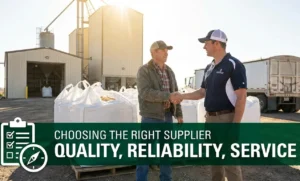
How Can You Select The Best Feed Supplier For Bulk Livestock Feed?
Begin With Feed Quality
All things must begin with quality. It doesn’t matter if the feed is the cheapest on the market. It’s not an inexpensive feed if its quality is poor. It’s simply not worth the cost if it brings about poor growth rate, poor milk yield, and poor health.
A good feed supplier has to be transparent on:
- Where the ingredients come from
- How their feed is formulated
- Lab Testing
- In how they ensure consistency from batch to batch
Never should you pick a supplier that is not able to explain what is in their feed, good suppliers are always proud of their products.
Consistency and Reliability: Just as Important as Quality
In fact, in bulk feeding, running out of feed and uneven quality could quickly become a problem. In fact, animals are creatures of habit and may be affected if there are changes in their feed, including:
- Intake
- Digestion
- Performance
- Admission
- Digestion
- Performance
Before selecting a supplier, ask yourself:
- Is the capacity for production adequate?
- Are they able to perform well even during peak periods?
- How accurate is their delivery schedule?
A supplier that is late with deliveries may cost you time. This may lead to you being stressed, which may in turn affect the performance of the animals.
Look for a Supplier Who Offers Flexibility
No two farms are the same. Your animal may have different nutrient needs depending on factors such as age, breed, climate, and purposes. This is why flexibility is important.
You get these from most good suppliers:
- Customized feed formulations
- Adjustments based on growth stages
- Seasonal ration changes
- Support during stress periods like heat, calving, or disease outbreaks
Select suppliers who understand your operations. They prove themselves to be more valuable than suppliers who provide one size fits all solutions.
Price Matters—but Not the Only Consider
It is hard to resist the option that costs the least to feed cattle. This is a problem, especially if the profit margin is low. However, low-cost feed always entails some “hidden costs”:
Rather than asking, “How much does it cost per ton?”, consider asking:
- How is this feed?
- What is the price per unit of nutrition?
- Will this feed improve growth or production?
- Could poor quality result in veterinary expenses or losses?
- Sometimes, a little extra spent upfront will yield huge results later on.
Verify Safety Standards and Certification
Feed safety is definitely an area where corners cannot be cut. Unsafe feed can cause severe health issues due to contamination that has been handled incorrectly.
A reliable supplier should follow:
- Recognised quality
- Personal safety standards
- Proper storage
- Transportation practices
- Regular audits
- Checks
- Labeling is clear
- Documentation
In other words, certifications are not mere documents. They demonstrate an adherence to the right process.
Technical Support – A Game Changer
And it’s not enough to be a supplier of the best food. To be perfect, you have to be a source of knowledge. It’s easy to tweak the diet with the help of technical support. They will help you and improve you faster.
Your suppliers would be providing these in 2026:
- Nutritional advice
- On farm visits or consultations
- Performance tracking
- Assist during difficult production periods
Think Long Term and Plan for Growth
Maybe your operation won’t be the same all the time. It is true that the size of your heard will increase. Your production levels will also change. But what if your feed requirements go up? You will want someone who is there to grow with you.
Ask yourself these:
- Can they scale up when it is required?
- Do they have the infrastructure for further growth?
- Are they looking for long-term relationships?
Changing suppliers one by one isn’t a good practice. Therefore, it is always better to choose one according to your future plans.
Conclusion
It may prove to be a difficult job to identify a suitable feed supplier for bulk livestock feed. However, it is more related to a strategic move rather than a purchase alone. The feed supplier makes a difference in animal health as well as efficiency.
By emphasizing quality, you position yourself for future success. A quality feed supplier is more than a supplier of feed to your farm. They help your livestock perform at their best.
FAQs
Q – Why is feed quality so critical for bulk livestock feed?
A – Feed directly affects
- Animal health
- Growth
- Productivity
Q – How can I be sure that the feed supplier will be reliable?
A – You have to check their:
- The delivery history
- Production capacity
- Customer feedback
- Openness in communication
A – Is customized feed really necessary?
A – Yes. Efficiency could potentially be enhanced by tailored feed.
Q – Should I Always Choose the Cheapest Feed Supplier?
A – Cheap feed is not going to perform well.
Q – How often should bulk feed deliveries be performed?
A – It depends entirely on what storage space you have and how many animals you raised. Consistency is more important than how often.
Q – What certifications should I be looking for in a feed supplier?
A – Accredited feed safety and quality certifications are required from your suppliers.
Q – How can i get myself a supplier for long term growth?
A – Look for these if you want a long term supplier:
- Scaleable operations
- Good logistics
- Commitment to long term partners