
 Get a quote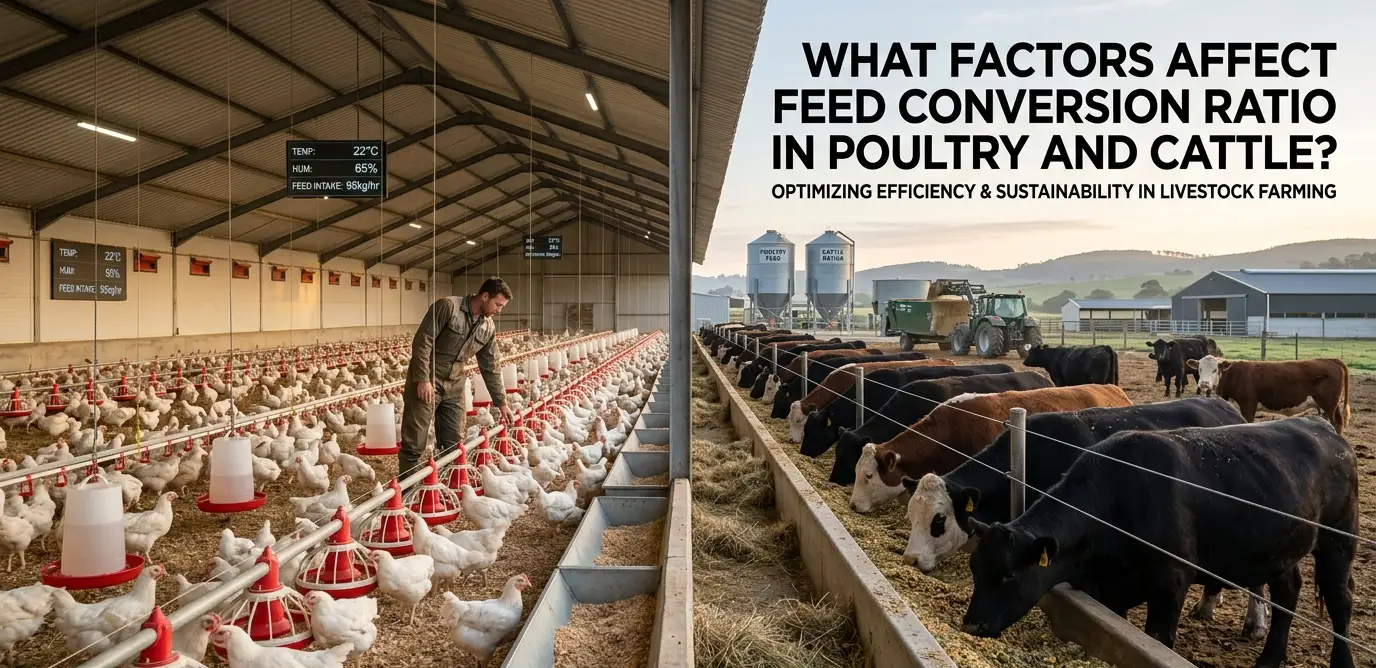
What Factors Affect Feed Conversion Ratio In Poultry And Cattle?
29 Apr 2026 - Admin
Improving efficiency is no longer optional in the fastly evolving livestock and poultry industry of India. It’s very much essential for profitability now. One of the major factors that contribute to the success of farms is feed conversion ratio in poultry and cattle. Feeding cost keeps increasing in India, and it is imperative for farmers to produce maximum output per kg of feed consumed. No matter whether you manage broiler units, dairy farms, or integrated livestock enterprises, one thing matters for all. You can reduce costs and increase productivity by understanding the factors affecting feed conversion ratio.
This guide explores the key factors which are influencing FCR in poultry and cattle. These come with practical insights all that are tailored for Indian farming conditions.
Key FCR Statistics in Poultry and Cattle (Quick Overview)
Below are the typical figures that are considered to be the benchmarks in livestock nutrition.
- Broiler chickens: 1.5 to 2.0 kg of feed per 1 kg increase in body weight
- Poultry layers: approx. 2.0 to 2.7 per kg of eggs produced
- Beef cattle: approx. 6.0 to 10.0 kg of feed per 1 kg increase in body weight
- Dairy cattle: approx. 1.1 to 1.4 kg of feed per 1 kg of milk production
Mostly, poultry is much more efficient in its feed consumption compared to cattle, which means feed quality is essential in cattle farming.
Source: FAO
What Is Feed Conversion Ratio (FCR)?
FCR stands for the ratio at which feed is converted into valuable production by animals. These could be body weight, milk or eggs.
FCR formula: FCR = Total Feed Consumption ÷ Total Production
The lower the value of the FCR, the more efficient the process of conversion. This is because fewer amounts of feed are required to produce the same amount of product. Improving FCR is the best way to increase profits from poultry and dairy farming in India.
What Are The Key Factors Affecting Feed Conversion Ratio in Poultry and Cattle?
Balanced animal nutrition in fact plays a very important role in how feed conversion ratio is improved. This also affects the overall productivity across poultry and cattle farming.
Feed Quality and Nutritional Balance
Feed quality is actually the most critical factor which affects feed conversion ratio in poultry and cattle.
- Balanced nutrients which improve digestion and absorption
- Poor quality feed increases intake but also reduces productivity
- Mycotoxins and contamination which are common in India’s humid climate reduce efficiency
You get optimal growth, better milk yield and improved overall performance if you just use poultry feed that is of high quality and is nutritionally balanced feed.
Genetics and Breed Selection
Genetics play a big role here in the way they affect the animal’s natural ability to convert feed efficiently.
- Commercial broilers are bred for low FCR
- Crossbred cattle often perform better than indigenous breeds in feed efficiency
You can improve performance under Indian conditions by choosing a region appropriate breed.
Feeding Practices and Feed Management
Proper feed management very directly affects the FCR.
- Overfeeding leads to wastage and higher costs
- Underfeeding reduces growth and production
- Feed form (pellets vs mash) affects digestibility
It’s essential to have consistent feedings schedules and proper storage practices. This is how you can maintain feed qualuty and efficiency especially when you’re using cattle feed raw materials.
Water Quality and Quantity
Water is a very important determinant of feed conversion ratio.
- Quality water aids efficient digestion and nutrient absorption
- Poor quality water leads to low feed intake
- Low water supply hinders efficiency
Improvement of water quality in India would greatly improve feed efficiency on farm animals.
Animal Health and Prevention of Diseases
- Animal health determines feed efficiency.
- Animal diseases hinder absorption of nutrients
- Parasites increase feed uptake without proportionate outputs
Health problems associated with the digestive system result in inefficient feed conversion
Health management practices are important to keep the FCR of animals at an optimum level. These include preventive healthcare, vaccination and biosecurity measures.
Climate and Environmental Conditions in India
The climate of India is an important determinant of FCR.
- High temperatures limit feed intake in birds and bovines
- High humidity levels encourage feed spoilage
- Seasonal changes have effects on the metabolism and growth
Good farm environmental management such as good ventilation plays an important role in improving feed efficiency in Indian livestock production.
Housing and Farm Infrastructure
Farms infrastructures greatly determine livestock productivity.
- Crowded conditions hinder growth
- Bad ventilation compromises respiratory health
- Unhygienic housing leads to disease threats
You can improve animal comfort and also support better feed conversion all with well-designed housing systems.
Age and Stages of Production
FCR differs according to various stages of growth.
- Youths have a relatively low FCR compared to mature individuals.
- Mature animals use more feed for each unit of product
- Efficiency of dairy cattle differs according to lactation stages
Development of appropriate feeding programs is crucial for optimizing production during each stage.
Feed Additives and Nutritional Innovations
In modern Indian livestock production, the use of feed additives is becoming common to increase FCR. You get better nutrient absorption and efficiency with Proper formulation that comes with using poultry feed raw materials.
- Enzymes boost nutrient absorption
- Probiotics improve digestive functions
- Toxin binding prevents contamination problems
This is an important component in optimizing FCR in poultry and dairy livestock.
Stress and Livestock Welfare
Stress can be considered a critical but commonly ignored variable that influences FCR.
- Improper handling decreases feed consumption
- Crowding causes competition for resources
- Environmental stress impacts metabolic processes
By minimizing stress via proper management, one achieves increased productivity and reduced FCR.
How to Improve Feed Conversion Ratio in Poultry and Cattle?
Some ways that farmers can use to increase their animals’ feed conversion ratio include:
- Using quality and well-balanced feed
- Provision of quality and constant water supply
- Adhering to appropriate hygiene and bio-security measures
- Regular checking of livestock animals’ health
- Optimal animal housing and ventilation
- Stage-appropriate feeding practices
Why Does Feed Conversion Ratio Matter in India?
Efficient utilization of feed conversion ratio for chickens and cows is important for:
- Lowering costs of feed (highest cost in farming)
- Enhancing output of milk, meat, and eggs
- Economical farming of livestock in India
- Sustainable agricultural practices
Due to rising demand for animal protein in India, efficient use of FCR is important.
Conclusion
Feed conversion ratio in poultry and cattle is in fact a key performance indicator which affects profitability and efficiency in livestock farming operations. There are many things that affect the feed conversion rate.
If you pay attention to them and make changes to your feeding and management techniques, you will see significant improvements in your feed efficiency.
If you wish to increase efficiency, consider partnering with dependable feed suppliers such as Prodigy Foods for premium feed solutions made specifically for India.
FAQs
Q – What is feed conversion ratio in poultry and cattle?
A – Feed conversion ratio in poultry and cattle basically measures the efficiency of converting feed into body weight, milk or eggs.
Q – What is considered a good FCR for poultry in India?
A – A good FCR for broiler poultry in India is 1.5 to 1.8.
Q – How can farmers increase the feed conversion ratio in livestock production?
A – Farmers can increase FCR by offering high-quality feed and having access to clean water. Good health and better management of farms also helps.
Q – Why does the feed conversion ratio matter in dairy farming in India?
A – It enables farmers to know the efficiency of converting feed into milk.
Q – Is there an impact of climate on feed conversion ratio in poultry and cattle?
A – Climate in India can affect the FCR since hot weather and humid conditions reduce feed consumption and cause poor FCR.
Q – Which is the critical factor influencing FCR?
A – The quality of feed is the most influential aspect determining the FCR.