
 Get a quote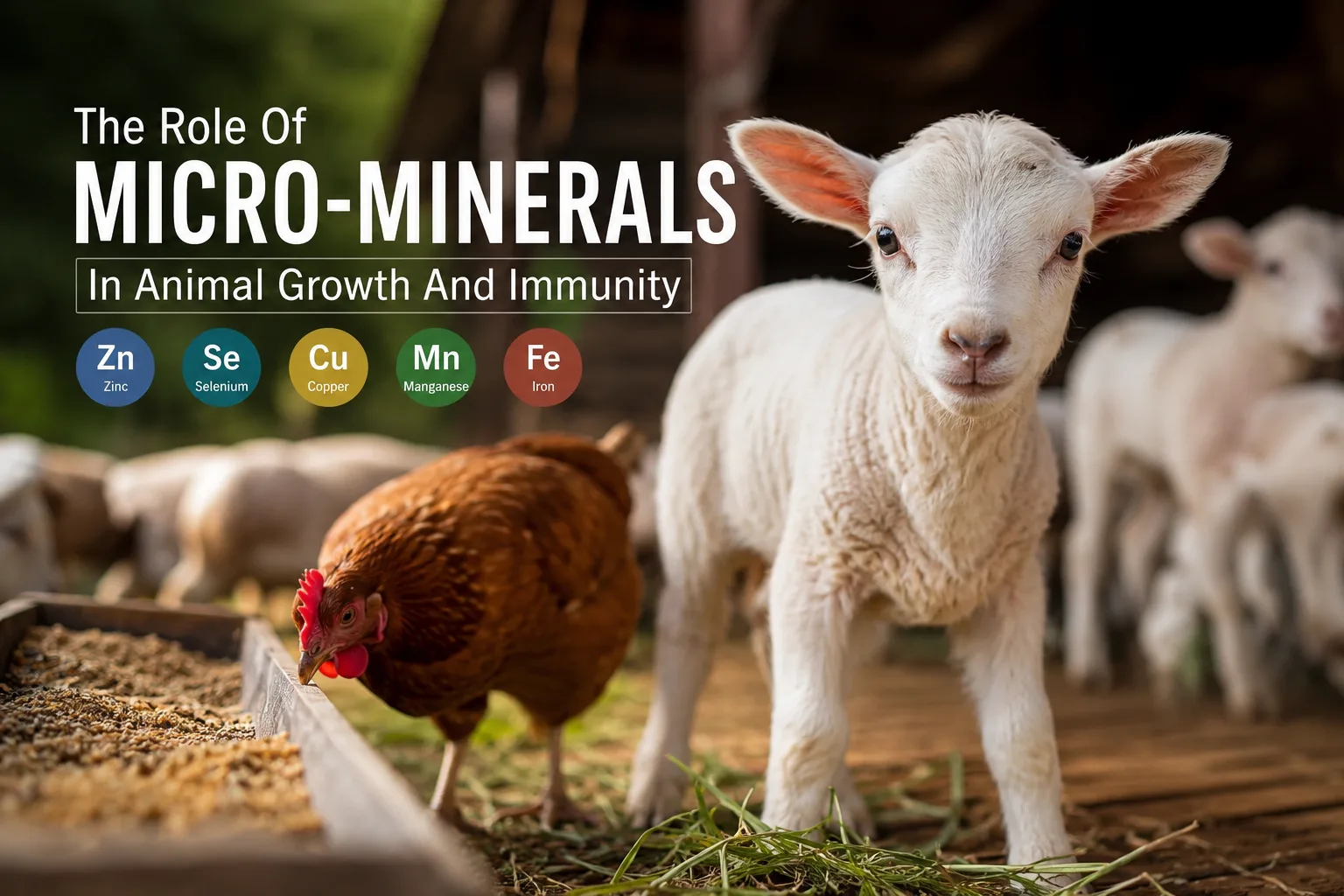
The Role Of Micro-Minerals In Animal Growth And Immunity
8 May 2026 - Admin
Indian livestock sector is an integral part of the livelihood, milk production and food security of the region. For farmers, healthy livestock can mean steady income. However, productivity is not restricted by genetic factors alone. Nutritional imbalances are among some of the most significant factors, especially with respect to the role of micro-minerals in animal growth and immunity.
Even though they are in minute quantities, minerals like these play a big role. Micro-minerals help in growth, immune function, reproduction, performance in general as far as cattle, buffalo, sheep, goat and poultry are concerned. Even with adequate nutrition, the lack of these trace minerals means that the animals do not achieve their maximum potential.
In studies conducted in various Indian regions, there is a notable trend in the soil-fodder-animal chain. Important micro-minerals like these Zinc (Zn), Copper (Cu), Selenium (Se), Cobalt (Co), Manganese (Mn), and Iron (Fe) are missing many times. In other words, the presence or rather absence of these trace minerals impacts the health of livestock; hence micro-minerals in animal growth and immunity become quite crucial.
Quick Stats: Micro-Mineral Deficiency in Indian Livestock Systems
According to the Indian Journal of Animal Sciences:
- The research conducted in central and northern parts of India revealed severe deficiencies of Cu and Zn in cattle feed and serum, having a major impact on their immune system and metabolic functions.
- Animals suffering from such deficiencies have low hemoglobin content, reduced levels of vitamins A and E, and poor immune response. Source: Indian Journal of Animal Sciences:
Therefore, the results clearly demonstrate that micro-minerals play an extremely important role in animal growth and immune functions in India.
What Are Micro-Minerals?
Micro-minerals or trace minerals are essential micronutrients which are needed in minute amounts (ppm levels). But still they govern significant physiological functions in living beings.
Essential micro-minerals comprise:
- Zinc (Zn)
- Copper (Cu)
- Selenium (Se)
- Cobalt (Co)
- Iron (Fe)
- Manganese (Mn)
- Iodine (I)
You may see a very drastic impact on growth, immunity, reproduction along with lactation efficiency with even a slight deficiency here.
Why Do Micro-Minerals in Animal Growth and Immunity Matter So Much?
It becomes a lot more clear why micro-minerals matter in animal growth and immunity when you look at the way they affect the animal physiology.
Stronger Immunity and Disease Resistance
A stronger immune system is no doubt one of the biggest benefits here of proper micro-mineral nutrition.
- Zinc supports white blood cell production which is what helps animals resist infection.
- Selenium acts as an antioxidant protecting cells from oxidative stress.
- Copper promotes anti-bacterial defense systems.
Inadequacy of these results in increased susceptibility to infections such as mastitis, diarrhea, skin diseases, and respiratory disorders. Recovery becomes slow, resulting in additional expenses in the form of veterinary bills.
More Effective Growth and Development
Feeding does not involve just more feed; it involves better feeding.
- Zinc actually supports protein synthesis along with muscle growth
- Bone development and joint health is benefitted with Manganese
- Proper oxygen transport in blood is ensured with iron.
A balanced composition of micro-minerals among livestock growth and their immunity will result in increased weight, efficient feed conversion, and improved physical condition. Any deficiency in this case results in slower growth and inefficiency.
Better Reproductive Health and Efficiency
Efficient reproduction is one of the most critical considerations in the Indian dairy industry.
- Micro minerals affect reproductive hormone levels:
- Zinc increases fertility and improves conception
- Copper promotes healthy reproductive cycles
- Selenium decreases embryonic death rates
- Iodine controls thyroid levels
Low levels can cause delays in heats and conception and produce unhealthy calves.
Resistance from Stress and Free Radicals
Indian farm animals may suffer from heat stress, particularly in the north and central areas.
Both selenium and copper have antioxidant properties that mitigate the stress caused by oxidation within the body. This will allow the animals to perform well despite any form of heat, infection, or stress due to transportation.
Why Is Micro-Mineral Deficiency Common in India?
Micro-mineral deficiency among animals is directly associated with the agricultural practices followed in India.
Reasons:
- Nutrient exhaustion from soils because of intense agriculture
- Feeding animals predominantly with crop residues like straw/stover
- Low diversity in the kinds of fodder crops
- No awareness about mineral deficiency among small-scale farmers
- Different soils containing varied amounts of minerals
As quality of fodder depends upon soil fertility, deficient soils lead to mineral deficiencies in the livestock.
Implications for Indian Livestock Economy
The impact of micro-mineral deficiencies is evident on farms as follows:
- Lower production of milk from dairy cattle/buffalo
- Higher occurrence of diseases, hence higher treatment expenses
- Decreased ability to reproduce
- Increased calf mortality rates
- Poor work ability in draught livestock
In layman’s terms, poor micro-minerals nutrition results in poor livestock economy.
How Can Farmers Improve Micro-Mineral Nutrition?
Balanced Mineral Mixtures
Balanced mineral mixtures can be used to fix mineral deficiencies fast.
Feed Fortification
Fortifying compound feed with important trace minerals increases nutrient uptake.
Improved Fodder Management
Increasing the diversity of fodder by incorporating legumes and grasses ensures increased mineral intake.
Soil Health Improvement
Healthy soil produces mineral-rich fodder which is good if you want to strengthen the entire food chain.
Chelated Mineral Supplements
Chelated mineral supplements are easily absorbable and are also a lot more effective even at low dosages.
Regular Veterinary Advice
Regular testing of blood and fodder helps recognize and fix deficiencies.
Why Does This Matters for India’s Future?
The livestock industry in India is thriving at an alarming pace, but inefficiencies still exist. Enhancement in micro-minerals in the growth and immune system of animals will enable:
- Increased efficiency in milk production
- Improved income for farmers
- Decreased disease prevalence
- Sustainable production of livestock
- Enhanced food security
This is no longer an exclusive problem in veterinary medicine.
Conclusion
The importance of micro-minerals for animal immunity and growth is far from being limited to the basic nutritional needs. Micro-minerals are responsible for immune response, animal growth, breeding, and productivity as well. Considering the fact that mineral deficiencies in the soil and diet are rather common in India, this problem should definitely be addressed.
The bottom line for farmers and livestock producers is clear – better micro-mineral nutrition results in healthy livestock and increased productivity.
FAQs about Microminerals in Growth and Immunity of Animals
Q – What are micro-minerals in animal nutrition?
Micro-minerals include trace elements such as zinc, copper, selenium, and manganese which are required in very small amounts in the diet.
Q – Why are micro-minerals important for animal growth and immunity?
They help in maintaining good functioning of the immune system and other biological functions in animals.
Q – Which micro-minerals are most commonly deficient in India?
Some of the micro-minerals deficient in India are zinc, copper, selenium, and cobalt.
Q – What are the symptoms of micro-mineral deficiency in animals?
Slow growth, poor immunity, infection, infertility, and low milk production are some of the most common symptoms.
Q – How can farmers ensure good micro-mineral nutrition for animals?
Through use of mineral mixes, feeding of fortified foods, fodder improvement, and veterinary advice.
Q – Can soil quality affect animal health?
Yes, low soil mineral levels actually result in poor fodder which affects animal nutrition and health.